

Why Companies Keep Choosing Chaos Over Consistency
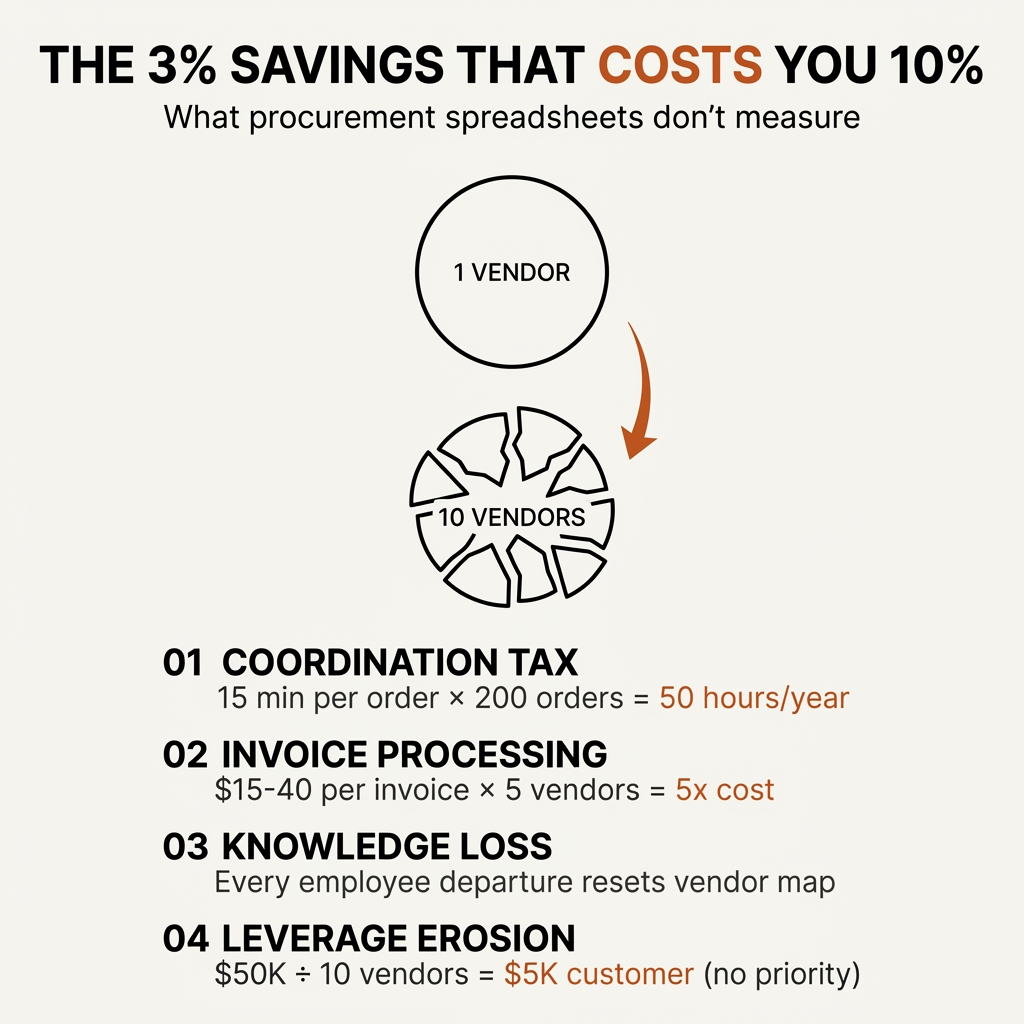
Multi-vendor purchasing strategies often cost more than they save. The 3% unit price savings companies chase get erased by hidden administrative costs, accountability gaps, lost institutional knowledge, and operational friction that never appears on procurement spreadsheets.
Companies fragment their purchasing because spreadsheets show lower unit prices across multiple vendors. But the spreadsheet does not capture the real costs. Someone needs to track which vendor sells what. Someone spends time figuring out who to call when orders go wrong. New employees have to learn a vendor map that exists only in other people’s heads.
These moments add up faster than anyone realizes.
What Makes Line Item Pricing So Misleading?
Procurement teams build spreadsheets that track unit prices, lead times, and contact information. They compare vendor A against vendor B and choose whoever offers the lowest number. This feels rational.
The spreadsheet measures the wrong thing.
When purchasing spreads across five or ten vendors, work gets created that never appears in cost analysis. Someone has to track what to buy from where. Someone has to maintain relationships with multiple account reps. Someone has to troubleshoot problems across different systems, different processes, different people.
That 3% savings on unit cost evaporates the moment teams spend an extra hour per week managing vendor relationships.
Companies process invoices at a cost ranging from $15 to $40 per invoice. When multiple invoices arrive daily from multiple suppliers, that administrative cost accumulates silently.
The Core Issue: Unit price optimization creates operational inefficiency that costs more than the savings it produces.
How Does Vendor Fragmentation Create Accountability Gaps?
An item arrives damaged. The buyer calls vendor A. They say it shipped fine from their warehouse. The buyer calls the shipping company. They say the package was fine at pickup. The buyer calls vendor A again. They are told to file a claim with the shipper. The shipper says the claim needs to come from the vendor.
Two hours spent on a problem that should take one phone call.
When working with a single vendor, accountability stays clear. One relationship. One point of contact. One person who owns the problem until resolution. That rep gets answers so the buyer does not spend afternoons playing phone tag.
The friction of managing different vendors creates gaps where problems fall through cracks. Nobody wants to own the issue when it sits at the boundary between two separate relationships.
The Pattern: Multi-vendor environments turn simple problems into complex coordination exercises that consume time without creating value.
Why Is Institutional Knowledge So Hard to Maintain Across Multiple Vendors?
Every company develops institutional knowledge about vendor relationships. This product comes from here. That supplier handles rush orders better. This rep responds faster.
This knowledge lives in people’s heads. It gets passed down through informal training. It exists in scattered spreadsheets that get updated when someone remembers.
Then someone leaves or retires. That knowledge walks out the door.
The new person rebuilds the entire map from scratch. They learn which vendor carries which products. They figure out who to call for different issues. They rediscover all the workarounds that made the system function.
Organizations lack visibility into existing purchases, leading to duplication or inefficient provider selection. Often there are vendors already vetted who provide other services that are not being used.
This is not a training problem. This is a structural problem created by fragmentation.
The Reality: Vendor fragmentation transforms organizational knowledge into a constant maintenance burden that grows with every new hire.
What Relationship Leverage Gets Lost With Vendor Fragmentation?
When $50,000 in annual spending spreads across ten vendors, the company becomes a $5,000 customer to each. Not a priority. Not getting the dedicated support that larger accounts receive.
Smaller customers do not get bad service. But when a problem needs escalation, when someone needs to go the extra mile, when flexibility matters on a deadline, the customer spending $50,000 with one vendor gets different attention than the customer spending $5,000 with ten.
Consolidated purchases serve as a strong bargaining tool for price negotiations. When buyers operate in silos, making purchases within the context of their own needs, they harm purchasing leverage across the entire organization.
Decentralized buying means multiple comparable purchases happen in parallel. Nobody sees the full picture. Nobody realizes the company buys the same items from three different vendors at three different prices.
The Math: Fragmented spending reduces negotiating power and makes it harder to see total procurement costs across the organization.
Why Did Automation Make the Multi-Vendor Problem Worse?
Technology was supposed to solve multi-vendor complexity. Procurement software promised to manage everything. Automated systems would track it all.
The opposite happened.
Automation made it easier to add more vendors. It made fragmentation feel manageable. Companies looked at new procurement platforms and thought they could handle ten vendors as easily as one.
Automation does not eliminate human work. It moves it around. Someone still configures the system. Someone still maintains vendor data. Someone still resolves problems that fall outside automated workflows.
Big national vendors moved to offshore support and automated systems. They externalized complexity onto customers. When buyers call for help, they talk to someone reading from a script who does not understand their industry and cannot make decisions without escalation.
The industry knowledge that comes from working with people who understand the business gets lost. The relationship continuity that absorbs friction before it becomes a problem disappears.
The Paradox: Technology designed to simplify vendor management instead enabled more fragmentation and shifted complexity onto customers.
Why Do Smart People Keep Making This Mistake?
The multi-vendor approach feels rational because the costs stay invisible.
Procurement spreadsheets show unit prices, lead times, and contact information. They do not show the fifteen minutes the office manager spent figuring out which vendor to call. They do not show the hour the accounting team spent reconciling invoices from five different sources. They do not show the frustration of explaining the industry to an offshore support rep for the third time this month.
These costs are real. They consume operational capacity. They slow down teams. But they never appear in the cost comparison that drives vendor selection.
Preparation of solicitations alone takes weeks or months, with staff investing hundreds of hours to get a solicitation ready. When these soft costs add together, they easily exceed thousands or tens of thousands of dollars per contract.
Market structure reinforces this pattern. Vendors benefit from client confusion. Fragmentation makes it harder for companies to see total spend. It makes it harder to negotiate better terms. It makes switching costs feel higher than they are.
The Hidden Truth: Procurement metrics measure what is easy to track instead of what matters for operational efficiency.
What Makes Consolidation Feel So Risky?
Companies know fragmentation creates problems. They feel the friction daily. But consolidation feels risky.
What if the single vendor cannot handle everything? What if they raise prices once they have all the business? What if competitive pressure that keeps vendors honest gets lost?
These concerns are not unreasonable. But they miss the larger pattern.
The risk of vendor consolidation feels concrete and immediate. The cost of vendor fragmentation feels abstract and distant. Companies stick with fragmented approaches even when evidence shows they are not working.
Sixty-eight percent of technology leaders now plan to consolidate vendors, with organizations targeting a 20% cut in vendor count. They are making this shift because hidden costs finally became visible enough to demand action.
The Shift: Fear of consolidation risk often exceeds actual cost of continued fragmentation until someone measures total system impact.
What Does Effective Procurement Actually Measure?
The procurement process needs to measure total system cost, not unit price alone.
That means tracking the time teams spend managing vendor relationships. It means calculating the cost of invoice processing across multiple suppliers. It means accounting for institutional knowledge that has to be maintained and transferred.
It means recognizing that a good rep at a single vendor moves things faster. That rep owns problems. They know the business. They absorb complexity upstream so buyers do not have to deal with it.
The most efficient organizations spend 21% less on procurement efforts than their peers, leading to 2.5x greater return on investment, according to the Hackett Group’s 2024 benchmark analysis.
This is not about finding the perfect vendor. This is about understanding what the real optimization target should be.
Optimizing for lowest unit price makes vendor fragmentation look sensible. Optimizing for operational efficiency, relational continuity, and total system cost makes consolidation look sensible.
The question is which optimization serves the business.
The Framework: Procurement efficiency comes from measuring total operational impact, not isolated unit costs.
What Pattern Keeps Repeating in Procurement?
This cycle plays out repeatedly. A company fragments purchasing to save a few percentage points. Hidden costs accumulate. Problems take longer to resolve. Team members get frustrated. Someone finally does the real math and realizes the savings were an illusion.
Then they consolidate. Operations smooth out. Problems get resolved faster. Teams spend less time managing vendors and more time doing their work.
Companies that figure this out early gain an advantage. They free up operational capacity that competitors waste on vendor management. They build relationships that absorb friction instead of creating it.
Companies that do not figure it out keep chasing unit price savings while operational efficiency slowly erodes.
The spreadsheet will never reveal which path a company is on. Operations show what is happening. Measurement needs to focus on what matters, not what is easy to track.
That 3% savings on paper might cost 10% in operational efficiency. The only way to know is to start measuring the right things.
Common Questions About Vendor Consolidation
What are the hidden costs of using multiple vendors?
Hidden costs include invoice processing time ($15 to $40 per invoice), coordination overhead, accountability gaps when problems arise, institutional knowledge maintenance, and reduced negotiating leverage from fragmented spending.
How does vendor fragmentation affect team productivity?
Teams spend extra time tracking which vendor sells what, maintaining multiple relationships, troubleshooting across different systems, and training new employees on complex vendor maps that exist only in other people’s heads.
What happens to purchasing power when orders spread across multiple vendors?
Fragmented spending reduces each relationship to a smaller account size, decreasing negotiating leverage and making it harder to get priority support or favorable terms. Companies lose visibility into total spend patterns.
Why does automation fail to solve multi-vendor complexity?
Automation moves complexity around rather than eliminating it. Someone still configures systems, maintains vendor data, and resolves exceptions. Automation made adding vendors easier, which increased fragmentation rather than reducing it.
How do companies know when vendor consolidation makes sense?
When the time spent managing vendor relationships, processing multiple invoices, and resolving coordination issues exceeds the unit price savings from vendor competition. Most organizations targeting consolidation aim for 20% vendor reduction.
What risks come with consolidating to fewer vendors?
Companies worry about losing competitive pressure, dependency on a single vendor, or limited product availability. These risks feel immediate, while fragmentation costs feel abstract, which delays consolidation decisions.
How should procurement measure total cost of vendor relationships?
Track administrative time spent on vendor management, invoice processing costs, problem resolution time, relationship maintenance overhead, and institutional knowledge requirements in addition to unit prices.
What makes vendor consolidation efforts succeed?
Success comes from measuring operational efficiency alongside unit costs, choosing vendors who absorb complexity upstream, and building relationships where accountability stays clear when problems arise.
Key Takeaways
-
Unit price savings from multi-vendor strategies often get erased by hidden administrative costs, coordination overhead, and operational friction that procurement spreadsheets never capture.
-
Vendor fragmentation creates accountability gaps where problems fall between relationships, turning simple issues into time-consuming coordination exercises.
-
Consolidated purchasing increases negotiating leverage and relationship priority while reducing the institutional knowledge burden that grows with every vendor added.
-
Automation enabled more vendor fragmentation rather than solving it by making complexity feel manageable while shifting operational burden onto customers.
-
Effective procurement measures total system cost including time spent on vendor management, invoice processing, and problem resolution rather than focusing solely on unit prices.
-
The most efficient procurement organizations spend 21% less effort than peers and achieve 2.5x better ROI by optimizing for operational efficiency instead of isolated unit costs.
-
Sixty-eight percent of technology leaders now plan vendor consolidation because hidden fragmentation costs finally became visible enough to demand action.